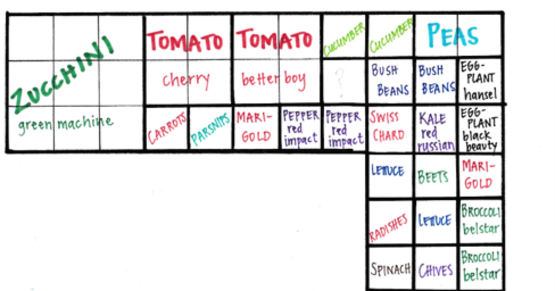
Square Foot Garden plan
“Grow a Row” (or a little extra) with Square Foot Gardening
The Backstory
This season several new Master Gardener volunteers (MGVs) from Otsego and Schoharie counties began a new initiative called Grow a Row, a community-powered project aimed at increasing access to fresh, locally grown food for families in need. Grow a Row encourages home gardeners to plant an extra row—or simply grow a little more—of fruits and vegetables to donate to local food pantries in Schoharie and Otsego Counties. By sharing a little from their gardens, participants can play a direct role in addressing food insecurity across the two counties. Additionally, growers and the public can receive gardening education and support from CCESO Master Gardener Volunteers. One example of this support is our Square Foot Gardening demonstration bed and program at the CCESO Grow Garden site at 123 Lake Street in Cooperstown.
MGVs and Square Foot Gardening (SFG)
Many of the MGVs involved in the project had heard of square foot gardening (SFG) and some had seen the 1980s television series or had read the book on it by the SFG creator, Mel Bartholomew, but few of us had tried to set up our food gardens employing those specific techniques. So, this demonstration bed would be somewhat of an experiment for us. For our Square Foot Garden demonstration bed, we did some research (a summary of our research and compilation of SFG resources can be found at the end of this article), then planned and planted the bed. Below are images of our initial plan and planting setup.
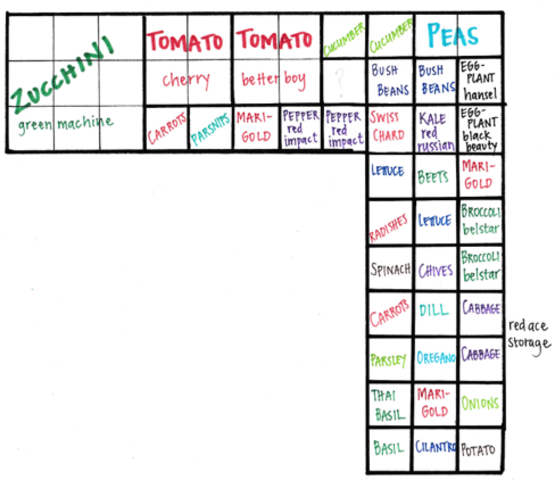
Square Foot Garden plan for demonstration bed
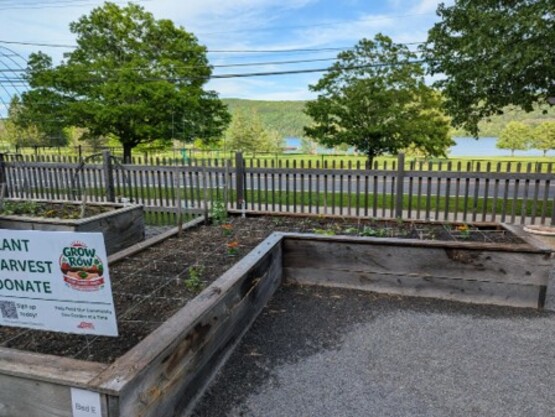
GAR Square Foot Gardening demonstration bed initial planting
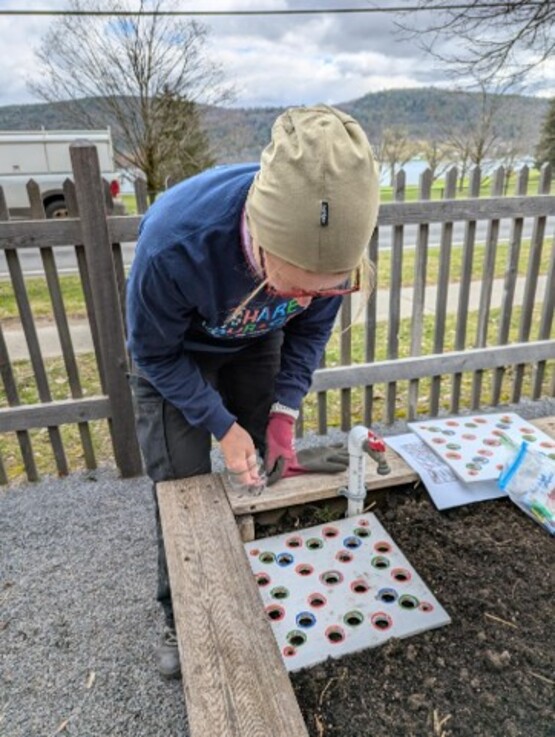
MGV using a planting template to evenly plant seeds in the bed
Summary of Our Research
What is Square Foot Gardening?
Square foot gardening is an intensive planting method that organizes a garden into one-foot squares rather than traditional rows. Developed and popularized by Mel Bartholomew, the approach helps gardeners maximize production in small spaces, reduce wasted area, and make gardens easier to manage.
Why Use Square Foot Gardening?
Traditional row gardening was designed for large agricultural fields that require equipment and walking paths. In home gardens, those paths often waste valuable growing space. Square foot gardening focuses on planting by area, allowing more vegetables to be grown in the same footprint. The method is especially useful for small yards, raised beds, beginners, and gardeners who want a productive and attractive landscape feature.
Garden Design and Construction
Most square foot gardens use raised beds, commonly 4 ft × 4 ft or 4 ft × 8 ft., although with little extra attention, inground beds can be used as well. Beds should be narrow enough that the center can be reached from the sides without stepping on the soil. The growing area is divided into one-foot squares using string, wood strips, twine, or a permanent grid. Aisles of about three feet provide comfortable access between beds.
Soil Preparation
Raised beds are typically filled with
high-quality growing media rather than native soil. A common recommendation is
a blend of compost, coconut coir or peat
Plant Spacing Principles
Each one-foot square contains a specific number of plants based on their mature size. Large crops such as peppers, cabbage, broccoli, cauliflower, eggplant, kale, and potatoes generally require one plant per square. Tomatoes and summer squash would require at least3-4squares, depending on how they are trained. Medium-sized crops such as lettuce, Swiss chard, celery, and many herbs can be planted four per square. Beets, peas, turnips, garlic, onions, and beans are often planted nine per square, while carrots, radishes, and green onions may be planted as densely as sixteen per square.
Plant Spacing With a Template
If you have laid out your bed with a 1 ft x 1 ft grid it can help the planting process if a SFG template or dibbler is used. Cut a 12” x 12” square of cardboard, heavy plastic, or wood. With a ruler, mark off 1.5 inch squares to help locate the common SFG spacing. At key intersections on the marked square drill or cut hold for the standard spacing for 1, 4, 9, or 16 plants per square foot and then color the holes to help with seed or seedling placement. Images of this are shown below.
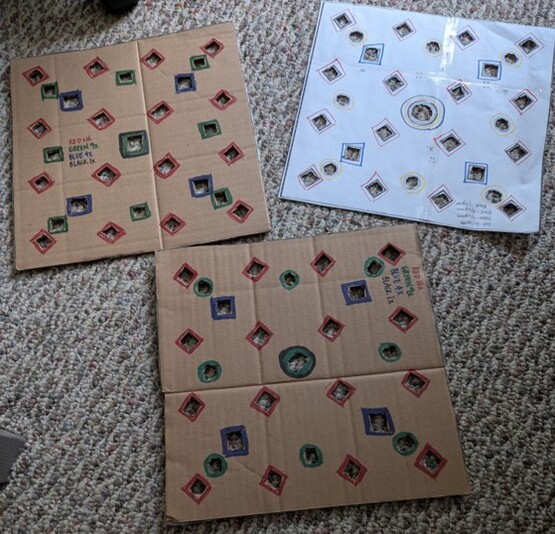
Three SFG templates made from cardboard with holes colored for standard spacing
Examples of Plant Density
Carrots illustrate the efficiency of the system. Instead of planting a single row, gardeners can divide each square foot into a grid and plant multiple carrots within that space. Across an entire bed, this can dramatically increase production compared with conventional row planting.
Watering and Fertility
Because more plants occupy a smaller area, square foot gardens often require careful attention to watering and nutrition. Consistent moisture and regular additions of compost help maintain productivity. Many gardeners can water small beds by hand, and morning watering is recommended to reduce disease pressure.
Weed and Disease Management
Closely spaced plants quickly form a canopy that shades the soil and suppresses weeds. However, dense plantings may reduce air circulation, which can increase the risk of certain plant diseases. Monitoring plant health, watering properly, and avoiding overcrowding beyond recommended spacing help minimize problems.
Using Vertical Space
Trellises increase productivity by supporting climbing crops such as cucumbers and peas. Position trellises on the north side of the bed whenever possible so they do not shade shorter crops.
Crop Rotation and Continuous Harvest
One advantage of square foot gardening is the ability to harvest and replant individual squares throughout the season. After harvesting a crop, add compost and plant a different vegetable or herb. This practice maintains soil quality and extends the harvest period.
Advantages and Limitations
Advantages include higher yields per square foot, efficient use of space, reduced weeding, improved accessibility, and suitability for raised beds. Potential limitations include increased water and nutrient requirements, the cost of building raised beds, and greater disease risk if plants become overcrowded.
Final Thoughts
Square foot gardening is a practical method for gardeners who want to grow more food in less space. Whether used in a raised bed or adapted to an existing garden, the technique emphasizes efficient spacing, healthy soil, and continuous production. With proper planning and maintenance, it can provide abundant harvests from even a small growing area.
Resources
Square Foot Gardening-CALS , Square Foot Gardening - CALS, 2021
Square Foot Gardening-IFAS , Square Foot Gardening UF-IFAS EXTENSION, 2026
Square Foot Gardening Foundation, Square Foot Gardening Foundation, 2026
All New Square Foot Gardening , 4th Edition, by Mel Bartholomew, 2025
Contact
Marcie Foster
Horticulture & Natural Resource Educator
mkf48@cornell.edu
607-547-2536 x235 ~ 518-234-4303 x124
Last updated June 30, 2026